
How to Clean a Blomberg Heat Pump Dryer: Lint Filter, Filter Drawer and Condenser
Need a technician in Burnaby, Surrey or New Westminster?
Call Doctor Appliance at 604-729-0499. $85 service call, included in labour if the repair goes ahead. We serve Metro Vancouver: Burnaby, Surrey, New Westminster, Coquitlam, Port Coquitlam, Vancouver, Richmond, Delta and Langley.
Call 604-729-0499 Book a Repair
If your Blomberg heat pump dryer is taking longer and longer to dry a load, check the filters before you book a repair. Blomberg’s own owner’s guide lists clogged filters as the first cause of long drying times and damp laundry. The good news: most of this cleaning takes a few minutes and needs no tools.
This guide covers the Blomberg heat pump dryers we see most often in Metro Vancouver homes, including the 24-inch DHP24400W and DHP24412W. Other Blomberg heat pump models use a very similar filter layout.
Why filters matter more on a heat pump dryer
A Blomberg heat pump dryer is ventless. It does not push hot air outside. Instead, the same air goes round and round: it picks up moisture from the laundry, passes through a heat exchanger behind the kick plate, gives up its water there (that water goes to the water tank or drain hose), gets reheated and goes back into the drum.
That closed loop is what makes these dryers so efficient, but it also means lint has nowhere to go. Every fibre that gets past the filters ends up on the fins of the heat exchanger. As the fins clog, airflow drops, cycles get longer, energy use goes up, and the machine works harder for the same result.
Blomberg puts it plainly in the manual: a dirty lint filter and filter drawer cause longer drying periods and higher energy consumption, and running the dryer without the filter drawer sponge in place will damage the machine.
The three places to clean
Your Blomberg heat pump dryer has three lint stops, plus moisture sensors that also need occasional attention:
- Lint filter (in the door opening) – catches most of the lint. Clean after every load.
- Filter drawer (behind the kick plate at the bottom front) – a two-level filter: a foam sponge and a filter cloth. Clean when the filter drawer warning light comes on; Blomberg says the light will remind you at most every 3 drying cycles.
- Heat exchanger fins, often called the condenser (behind the filter drawer) – vacuum gently from time to time.
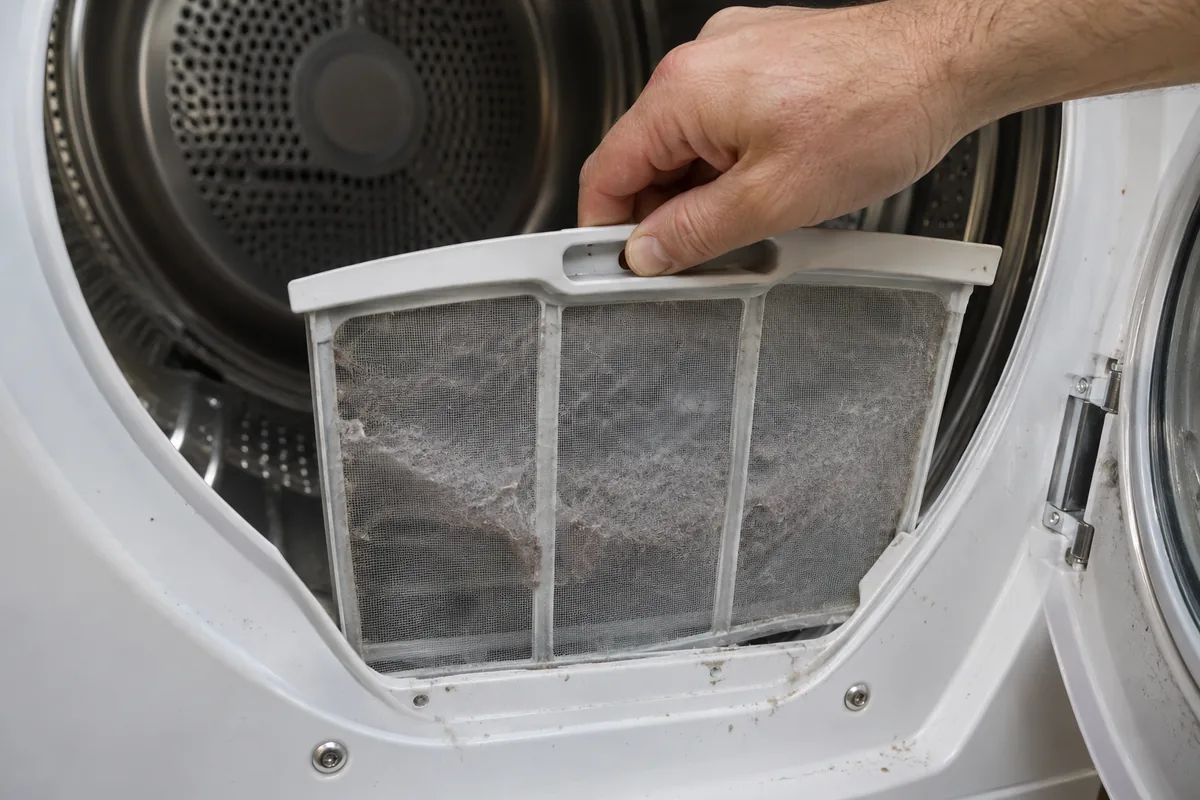
Step 1: Clean the lint filter after every load
- Open the loading door.
- Pull the lint filter straight up out of its housing and open it.
- Remove the lint by hand or with a soft cloth.
- Close the filter and put it back.
- Wipe the inside of the door and the door gasket with a soft damp cloth. Lint left on the gasket can stop the door from sealing and cause water to leak from the door.
You can also vacuum the lint filter housing (the slot the filter sits in).
Step 2: Wash the lint filter properly – at least once a year
This is the step most people skip, and it is the one our technicians see causing the most trouble.
Fabric softener and detergent residue slowly build an almost invisible film on the mesh. The filter looks clean, but air can no longer pass through it. A simple test: hold the filter under the tap. If water sits on the mesh or beads up instead of running straight through, the pores are blocked.
How to wash it:
- Rinse the filter under warm running water with a little mild dish soap.
- Do not scrub it with a brush. The mesh on Blomberg filters is very fine, and a brush simply does not get into the pores. Let the soapy water run through the mesh and rub it gently with your fingers, then rinse well.
- Let the filter dry completely before you put it back.
Our recommendation: do a full wash at least once a year, and more often if you use fabric softener or dry a lot of towels and fleece.
Step 3: Clean the filter drawer (sponge and filter cloth)
When the filter drawer warning light comes on:
- Press the kick plate button to open the kick plate at the bottom front of the dryer.
- Turn the filter drawer cover in the direction of the arrow and remove it.
- Pull out the filter drawer.
- Press the red button to open the drawer.
- Take out the foam sponge.
- Remove the lint from the filter cloth by hand or with a soft cloth. If you see a layer building up on the cloth, wash it in warm water and let it dry thoroughly.
- Wash the sponge by hand, squeeze out the excess water and let it dry well. If there is only a little lint on the sponge, you do not need to wash it every time.
- Put the sponge back, close the drawer until the red button locks, slide it in, turn the cover back in the direction of the arrow and close the kick plate.
Never run the dryer without the sponge in place. Lint then goes straight onto the heat exchanger, and that is a repair, not a cleaning job.
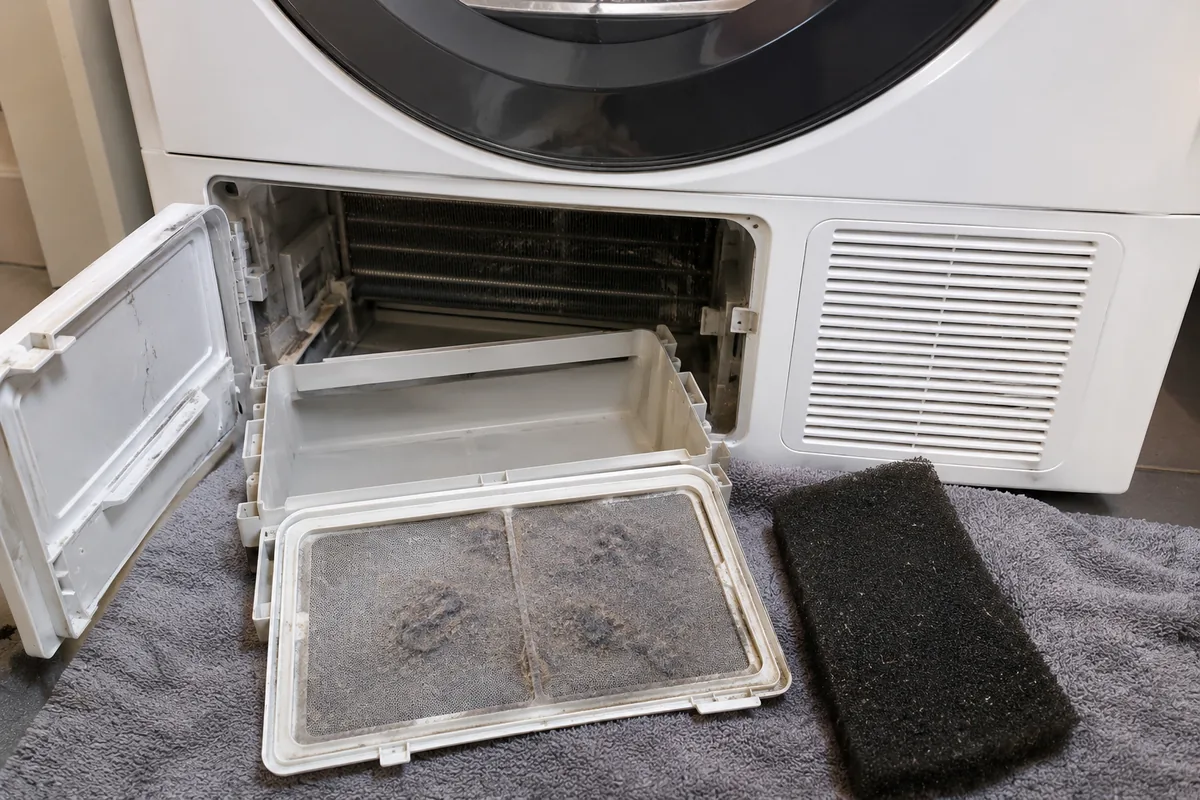
Step 4: Vacuum the heat exchanger (condenser) fins
With the filter drawer out, you can see the fins of the heat exchanger behind it. Blomberg calls this part the evaporator; most people call it the condenser.
- Vacuum the lint off the fins with a soft brush attachment.
- Work gently and do not bend the fins.
- If you clean by hand, wear protective gloves. The fins are thin and sharp enough to cut your hands.
If the fins are packed solid with lint, or the lint is wet and matted, stop there. Pulling hard at it can damage the fins, and a blocked heat exchanger usually needs a technician to clean it properly.
Step 5: Wipe the moisture sensors
Your dryer decides when the laundry is dry using metal moisture sensors inside the drum. Mineral deposits on them can make the dryer stop too early or run too long.
- Let the dryer cool down.
- Wipe the metal sensor strips with a soft cloth dampened with vinegar, then dry them.
- Do this about 4 times a year. Do not use metal tools on the sensors.
Cleaning schedule
| What | How often |
|---|---|
| Lint filter – remove lint | After every load |
| Door and gasket – wipe | After every load |
| Lint filter – full wash with soap | At least once a year |
| Filter drawer sponge and cloth | When the warning light comes on (at most every 3 cycles) |
| Heat exchanger fins – vacuum | When you see lint on them |
| Moisture sensors – vinegar wipe | About 4 times a year |
Mistakes that damage Blomberg dryers
- Running the dryer without the filter drawer sponge.
- Putting the lint filter or sponge back while still wet.
- Cleaning anything with solvents or strong cleaning products. Blomberg warns against this because of the risk of fire and explosion.
- Scrubbing the fine mesh with a stiff brush.
- Bending the heat exchanger fins.
- Ignoring a flashing lint filter light. A light that stays on means “clean the filter”. A flashing light means something more: the filter housing is clogged, the mesh has a deposit on it, or the filter drawer is blocked.
When cleaning is not enough
Call a technician if, after a full cleaning:
- The dryer still takes much longer than it used to, or the laundry comes out damp (see Blomberg dryer not drying).
- Warning lights keep flashing (see Blomberg dryer warning lights).
- Water leaks under the machine or the tank is not filling (see water tank and drain hose).
- The dryer shows no lights at all and you hear a ticking or clicking sound. In our experience this usually means the main control board has failed (see Blomberg dryer control board, and how to protect your control board).
Our technicians repair Blomberg heat pump dryers across Metro Vancouver every week, including main control board repairs. Learn more about our Blomberg dryer repair service or see our prices.
Save $25 on your Blomberg dryer repair: see the offer and terms on our coupons page.

FAQ
Remove the lint from the door filter after every load. Clean the filter drawer sponge and cloth when the filter drawer warning light comes on, which is at most every 3 cycles. Wash the lint filter with soap and water at least once a year.
Yes. Blomberg recommends washing the lint filter in warm water when a layer builds up on the mesh. We recommend warm running water with a little mild dish soap. Let it dry completely before putting it back.
Check the filter drawer sponge and cloth behind the kick plate and the heat exchanger fins behind it. Also check the moisture sensors, the load size and the washer’s spin speed. If drying is still slow, the heat exchanger may be blocked deep inside or a component may have failed. That needs a technician.
No. Blomberg warns that drying without the filter drawer sponge will damage the machine, because lint goes straight onto the heat exchanger.
It sits behind the filter drawer, behind the kick plate at the bottom front of the dryer. Blomberg’s manual calls it the evaporator. You can vacuum the visible fins gently with a soft brush. Wear gloves, because the fins are sharp.
Need a technician in Burnaby, Surrey or New Westminster?
Call Doctor Appliance at 604-729-0499. $85 service call, included in labour if the repair goes ahead. We serve Metro Vancouver: Burnaby, Surrey, New Westminster, Coquitlam, Port Coquitlam, Vancouver, Richmond, Delta and Langley.
